
Social media growth tools can save time, improve consistency, and help teams scale content, engagement, and reporting, but only if the tools match the real bottleneck in your workflow. The best social media growth tools in 2026 support authentic execution instead of faking engagement.
This comparison breaks down which social media growth tools are best for X, scheduling, analytics, audience research, and multi-platform operations, plus how to build a lean stack that still converts.
Quick extraction block for readers, search engines, and AI answer surfaces.
TL;DR
The best social media growth tools in 2026 help teams scale authentic content, engagement, and analytics instead of faking traction with unsafe automation.
Best For
- •Growth teams comparing social tool stacks
- •Creators choosing between scheduling, analytics, and engagement products
- •Founders who want safer X-first growth tooling
Key Takeaways
- •Tool selection should start from your bottleneck, not the biggest feature list.
- •X-focused users need reply quality, monitoring, and analytics more than bulk automation.
- •One well-used tool stack usually outperforms a bloated collection of overlapping products.
Recommended Next Steps
- 1Choose one primary job to improve first: engagement, scheduling, analytics, or audience research.
- 2Compare your current workflow against the article's tool matrix before adding new software.
- 3If X is the main channel, test a tighter workflow built around persona-aware engagement and monitoring.
On this page
Why Most Social Media Growth Tools Fail
The social media growth tool market is crowded with products that promise follower counts but deliver engagement that looks good in a dashboard and means nothing in the real world. In 2026, the platforms have gotten significantly better at detecting and suppressing inauthentic activity — which means the old playbook of bulk follows, auto-likes, and generic comment bots is not just ineffective, it's actively harmful to your account.
The tools that actually work share a common trait: they help you do *more of what works* rather than *fake what works*. With that framing, here are the 12 best tools we tested.
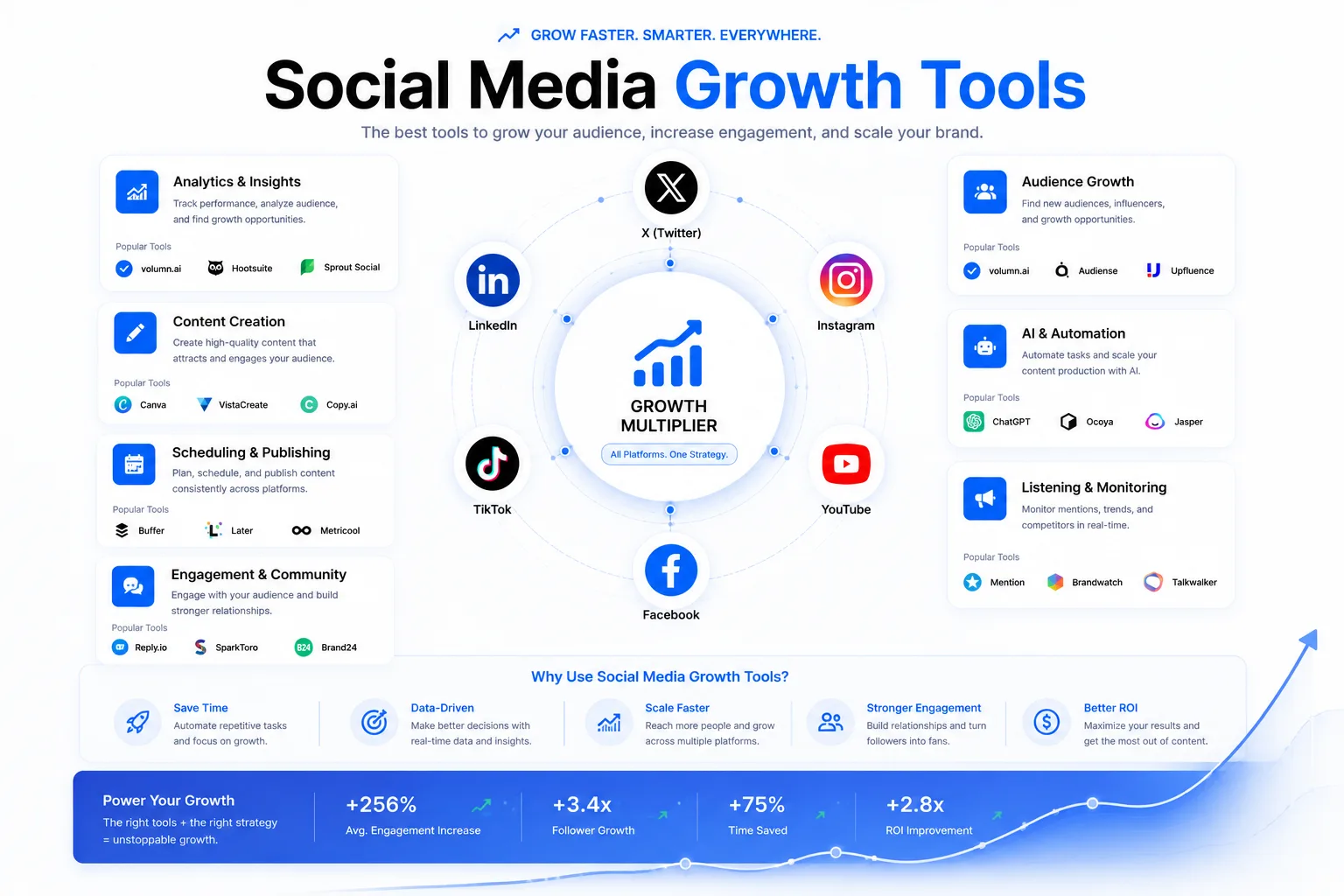
The Top 12 Social Media Growth Tools
1. Persona-Aware AI Engagement Tools — Best for X (Twitter)
What they do: The best X-focused engagement tools combine AI persona management, automated replies, and audience intelligence. They're designed for founders, creators, and growth teams who want to scale their X presence without sacrificing authenticity.
Standout features to look for:
- AI Reply that generates persona-matched responses that sound like you, not a bot
- Engage Bot that monitors target accounts and replies automatically within configured parameters
- Monitor that surfaces trending conversations in your niche before they peak
- Multi-account support with per-account credit caps and safety controls
Best for: X-focused growth teams, SaaS founders, personal brand builders
Notable option: goglobal.to for Reddit and SEO-driven growth alongside X
2. Hypefury — Best for Content Scheduling
What it does: Hypefury is a scheduling and content repurposing tool built specifically for X. It's particularly strong for creators who produce a high volume of content and need to manage a consistent posting cadence.
Standout features:
- Auto-retweet and auto-plug (add a CTA to your best-performing posts)
- Inspiration feed to find content worth engaging with
- Thread composer with preview
Best for: Content creators, newsletter writers
3. Taplio — Best for LinkedIn Growth
What it does: Taplio is the LinkedIn equivalent of a growth stack — content scheduling, AI writing assistance, and relationship management in one tool.
Standout features:
- AI-powered post generation trained on viral LinkedIn content
- CRM-lite for tracking relationships with target accounts
- Analytics dashboard with reach and engagement trends
Best for: B2B founders, consultants, LinkedIn-first brands
4. Shield Analytics — Best for X Analytics
What it does: Shield provides deep analytics for X that go far beyond what the native platform offers — including historical data, content performance breakdowns, and audience growth tracking.
Best for: Data-driven creators who want to understand what's working
5. Typefully — Best for Thread Writing
What it does: Typefully is a distraction-free thread composer with scheduling, analytics, and collaboration features. It's the tool of choice for many professional writers on X.
Best for: Writers, journalists, thought leaders
6. Publer — Best Multi-Platform Scheduler
What it does: Publer supports scheduling across X, LinkedIn, Instagram, Facebook, TikTok, and more from a single dashboard.
Best for: Social media managers handling multiple platforms
7. Phantombuster — Best for Automation Workflows
What it does: Phantombuster provides a library of automation "phantoms" for extracting data and automating actions across social platforms. More technical than most tools on this list.
Best for: Growth hackers, technical marketers
8. Followerwonk — Best for X Audience Research
What it does: Followerwonk lets you search X bios, analyze follower overlap between accounts, and find the best times to post based on when your audience is active.
Best for: Audience research, competitive analysis
9. Sprout Social — Best for Enterprise Teams
What it does: Sprout Social is a full-featured social media management platform with publishing, engagement, analytics, and listening tools.
Best for: Enterprise marketing teams, agencies
10. Buffer — Best for Simple Scheduling
What it does: Buffer is the simplest scheduling tool on this list — clean interface, reliable posting, basic analytics. No frills.
Best for: Solo creators, small businesses
11. Audiense — Best for Audience Intelligence
What it does: Audiense provides deep audience segmentation and intelligence for X, helping you understand who your followers are and how to reach more people like them.
Best for: Brand strategists, market researchers
12. Tweetdeck (X Pro) — Best Free Option
What it does: X's native power-user interface, now called X Pro. Multiple column layout, real-time monitoring, basic scheduling.
Best for: Anyone who wants a free, native solution
How to Choose the Right Tool
The right tool depends on your primary goal:
| Goal | Best Tool |
|---|---|
| Grow on X with AI assistance | Persona-aware AI engagement tool |
| Schedule content consistently | Hypefury or Typefully |
| Grow on LinkedIn | Taplio |
| Deep analytics | Shield Analytics |
| Multi-platform management | Publer or Buffer |
| Audience research | Followerwonk or Audiense |
The Bottom Line
The best social media growth tool is the one you'll actually use consistently. Start with one tool that addresses your biggest bottleneck — whether that's content creation, scheduling, engagement, or analytics — and master it before adding more to your stack.
Quick Comparison Table
| Tool | Best For | Main Strength |
|---|---|---|
| AI engagement tools | X growth | Persona-aware engagement and monitoring |
| Hypefury | Scheduling | Fast publishing cadence |
| Taplio | B2B content workflows | |
| Shield Analytics | Measurement | Strong historical reporting |
| Publer | Multi-platform ops | Centralized dashboard |
| Phantombuster | Technical automation | Flexible workflows |
Related Workflows
If X is the channel that matters most, pair this guide with Understanding the X Algorithm, Reply Agent, and Schedule so your tool stack actually maps to a repeatable growth loop.
If X is your primary channel and you want to scale genuine engagement without spending hours in the app every day, look for an AI engagement tool that prioritizes reply quality and persona consistency over raw volume. goglobal.to is also worth exploring if Reddit and SEO are part of your growth mix.
Decision Framework
If you only have one budget line this quarter, start with the tool that removes your biggest bottleneck:
| Bottleneck | Best Tool Type | Why |
|---|---|---|
| Low engagement | Reply and monitoring | You need better conversation quality first |
| Inconsistent posting | Scheduler or writer | You need repeatable output |
| Weak analytics | Reporting layer | You need to know what worked |
| Too many platforms | Multi-platform manager | You need operational simplicity |
What a Good Stack Looks Like
A good stack is small. It usually has one content tool, one engagement tool, and one measurement layer. If a tool does not improve one of those three things, it probably adds complexity instead of value.
For X-first teams, that often means:
- a writer for drafts,
- a monitoring layer for timing,
- a reply workflow for engagement,
- and a scheduler for consistency.
That is enough to run the system without turning your process into maintenance work.
Mistakes Teams Make
- Buying too many tools before defining the bottleneck.
- Using a scheduling tool without a content system.
- Tracking analytics without acting on them.
- Automating engagement without a clear tone or persona.
- Switching stacks every time a campaign underperforms.
Recommended Workflow
The cleanest setup is to choose one tool for content, one for engagement, and one for reporting. Then spend your energy improving the inputs:
- better hooks,
- tighter positioning,
- more relevant conversations,
- and a weekly review habit.
That is what keeps the stack useful long after the novelty wears off.
Internal links
Continue into tools, features, and conversion pages
This section keeps each blog page connected to at least one tool page, one feature page, and one use-case or alternative page so traffic does not stay isolated.
tool
Best Time to Post on Twitter
Pair your tool stack with stronger timing decisions and audience activity windows.
Open page →feature
Schedule
Learn how the scheduling workflow fits into a broader publishing and engagement system.
Open page →alternative
Social Media Post Maker Tools
Compare drafting and creation tools if content production is the real bottleneck.
Open page →Quick Answers
Common questions this article answers
These short answers make the core guidance easier to scan while staying collapsed until a reader opens a specific question.
Official product references
Verify product facts with docs and help pages
This blog post is designed to explain strategy, context, and recommended workflows. For feature availability, setup steps, billing details, and compliance rules, use the official Volumn.ai references below as the source of record.
Help center guides
Canonical setup steps, workflows, and feature guidance from the consolidated help center.
Open reference →Help center
Official explanations for product behavior, billing details, integrations, and compliance.
Open reference →FAQ
Fast answers for pricing, credits, safety rules, and account-level product questions.
Open reference →